
by Motormouth Jamie
 If you are reading this article, chances are you read the fantastic retelling of the Legion’s Solium Infernum game, retold by our good editor Will. It is a game of playing archdemons vying for control of Hell after Satan left to do whatever it is fallen archangels do when they get bored. It was a fun game, one to which I was bested with his skillful lying (please do not read Turn 55 of that article, it is incredibly embarrassing for me), but it has drawn my mind to another game, a TTRPG, with a similar narrative, that of Satan leaving his domain behind and leaving the other powers to vie for control. A game where you play as souls trapped in a post-Rapture Earth where the angels never came down to end it. A game of playing as bad people trying to make the best of the hand they were given and maybe, just maybe, they could make a slice of Hell-on-Earth seem a little less more tolerable.
I am talking about Astro Inferno, by Haxan Studios. A game which I love while reading and get infuriated trying to run.
Hello again. This is Motormouth Jamie, your go-to guide for TTRPG opinions and suggestions within the BPL. As those who have read my previous articles, you will be aware that I keep a keen eye on the crowdfunding market of games, both for big successes and niche indie projects. A part of me wanted to write about the flabbergasting success of the Dungeon Crawler Carl campaign of BackerKit – $12 million dollars earned for a game about a man in his underwear in a planet sized megadungeon – and other similarly mega successes. Yet, the loss of that Solium Infernum game still lingers on my brain and Astro Inferno was also a crowdfunded project, one which earned less than the light-novel tie-in but still earning a respectable $178 thousand dollars. I backed it, for the sake of openness, because it promised a mature (read: 18+) game steeped in science-horror tropes and esotericism and world that would not shy away from the context of living in Hell.
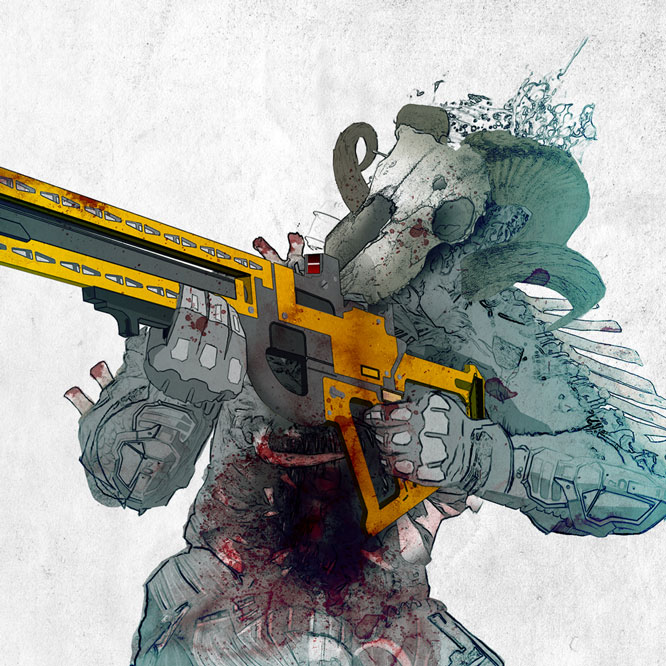 At its core, Astro Inferno places you as a Death Singer. This being a post-Rapture world that started in our near-future, the Satanic Court rules and, with Papa Satan disappearing, older divinities and manmade demiurges have appeared to try and take power for themselves, entities who have granted you the ability to come back from the dead. Your patron could be an archdemon, an ancient god of Chthonic or Egyption origin, maybe even the Machine Angels that mankind produced during the end times, but all want you to gain power and bring death to their enemies. You yourself could be from a few forms of origin, be you a rare uncorrupted “Undying” human, a Dark Soul steeped in post-Rapture corruption, a besouled AI, or even a Satanic Entity yourself, blessed/cursed with mutations and heavy ordinance that grants you great power. You are not a damned, sniveling soul in Astro Inferno, you are an uplifted demigod and you will bend the world to your desires.
This is a d20 “roll under” system, in that your character must roll under the called upon stat or skill to succeed, with the lower you rolling the better. Every 5 points you rolled beneath your target number gives you Story Points, used to alter the scene with “truths” and “aspects” (permanent and temporary story elements respectively) and improve your skill: you may, for example, roll so well on a Satisfy test to negotiate with a demon that you introduce a truth that the demon is secretly a traitor to their lord and will be willing to help you. Considering target numbers can reach all the way to 50 – if rarely – you could be throwing around a good many aspects and truths, which I find to lead to hilarious and creative problem-solving methods.
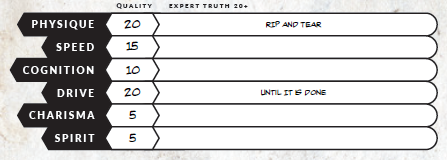 To explain core elements of Astro Inferno, I will give you some examples of characters you could play. The first is a character I call The Slayer. An Undying man in a power armoured suit with a heavy shotgun who is too angry to die. Yes, the Doom Guy was the primary inspiration. The Slayer is strong, has a great conviction, and as such his highest stats gained truths about himself which could be invoked to gain a bonus to dice rolls in game. His Physique was high and thus I gave him the truth “rip and tear”, hear meaning he would gain a free story point when he was using his Physique to be as brutal as possible. He was built as a combat powerhouse, his patron being a spirit of courage and being driven by an inner sin of wrath, his Asgardian shotgun blessed by the Seven Knights gaining power the more he slayed enemies before him. What is an Asgardian shotgun? Who are the Seven Knights? That was up to you; Astro Inferno gives you control to take their keywords and write what you see to be meaningful to your character concept.
Which leads us to what I, my players, and my own GM consider to be the weakest point of the system: for a game set in a bloody world of torture and might makes right mentality, the combat in the system stumbles. The game shines in its narrative control, the story points are fantastic in building a shared, dynamic narrative with your players, but the combat system is comparatively dull. Each “verse” (round, we are singers after all) starts with the GM saying what will happen if an entity is not slain then alternating rounds between players and enemies to see if the players can kill the cause of the trouble or fix it in some ways. An issue with this system, however, is that it is not entirely clear how a conflict is meant to be set up. After multiple readings, it became clear that you only ever have one adversary in an encounter (this is not clear in the text itself), like a group of soldiers or a single monster, and playing with a smaller group than what we suspect to be three to four players ends up with the declared trouble occurring as it shall always do so once all player activations have concluded. The Slayer, alas, could never be a one-man army. It was bloody, it was lethal, it felt less fun than keeping to skill challenges.
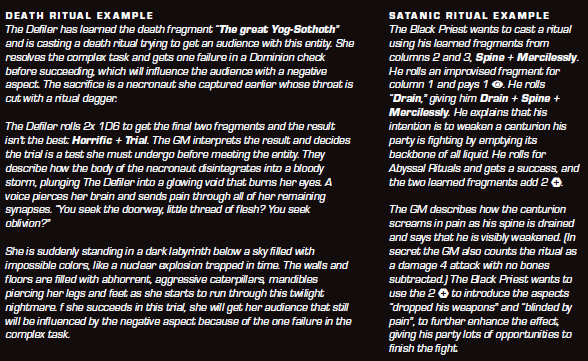
While combat felt like a chore, the magic system is, in my mind, one of the greatest things about Astro Inferno. In this system, there are three modes of rituals: Abyssal rituals of sacrifice and Satanic power; mistrusted Divine sorcery of prayer and prophecy; and Witchcraft which is more alchemic and inventive. All forms of ritual require fragments, words of power, which you string together in ways dependent on your type of ritual to gain an effect. For example, my second character, the Last Word, was a practitioner of Celestial magic, having the power to create and weave fates for characters. They sold this power as a service, able to proclaim the fragments of Beautiful, Focused, and Fertility to ensure a character might have success conceiving an uncorrupted child. On the flip side, with Aetheric divine magic, I could use the words Penetrating, Bone, and Chains to skewer my enemies with spikes of ivory and hold them in place. It is a very versatile system, one which can get very freaky when you add cruder Abyssal fragments like Bowels, Rancidly, or even Genitals to the mix.
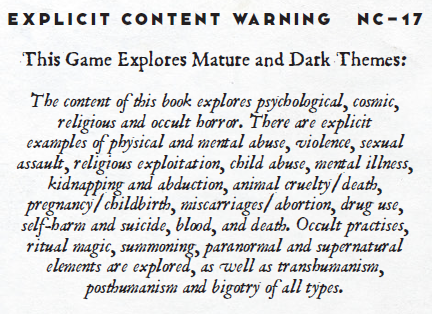 This brings us to an important aspect of the game which many may find off-putting. This is a game whose rulebook keeps a stamp warning readers it is not suitable for child or sensitive souls on its cover and lists a trigger warning which I have embedded beside this paragraph. It is a game set in Hell-on-Earth and treats the idea with the full expectation of what that would mean. It can also be crude in ways that some would find distasteful; when randomly rolling for fragments for the Last Word, I managed to pick up “Fucking” and decided to reroll “Shit”. Could I have cursed people to have a subpar sex life for all their days with this power? Yes. It could also turn dysentery and sexual disease into a weapon. At some tables, this might be funny and played with some witty irreverence but it may not be for you. It could also mean an uncomfortable moment where the witch amongst you effectively sexually assaults an enemy through arcane means to kill them. Consider your safety tools should you get into this game, they will be necessary.
That said, with all the possibilities that things could go dark, it allows you to revel in playing as a monster in a similar manner to Vampire the Masquerade. You are likely going to play a bad person, villainous in any other setting, but are considering heroic and moral compared to what is around you. For my third and last example, I created the Black Wyrm, a Satanic Entity that was, as the name suggests, a dragon. He had multiple corruptions – mutations – like having a skeletal tail that could be used as a serious weapon and “birdlike head-features” which connected it to the Egyptian powers for casting arcane arts. They were a hunter of the worst sinners, victimisers, consuming them whole along with what bronze and gold the people of Golgata could sacrifice to it. It was a monster, a nightmare, and a hero. So few games allow you to play that kind of narrative, let alone bake it into the core system itself!
Astro Inferno is wonderfully dark and narratively focused and messy. It struggles to tell you how to run a game with its rules, a pitfall I find many games struggle to jump over, lacking direction given to a GM on how to plot a campaign or even set up a verse that will be challenging at your players’ current power level. That said, Haxan Studies has released their first adventure path, the Crown of Ruin, which may be able to give you some direction. It even comes with space ship mechanics and plentiful resources on how to operate in the economy of a sorcery-fuelled world. I highly advise anybody interested in bleak settings that you can make brighter through your actions to give it a try and any would-be game developers to see what a system with great ambition but perhaps a little too much bloat looks like. Character oozes from this game like black honey, why not indulge a little?
Jamie’s Homebrew Corner
I have had people ask me to keep them updated on my Corsair homebrew after discussing it in my last update. As I am a generous demiurge, I will continue to publish any preview updates after my articles from here on out. As such, I present the previews for the Armoury and Vehicles sections for Dancing in the Ashes! Useful not only for playing as Aeldari but also as antagonists in your pre-existing games. What radical inquisitorial acolyte doesn’t want to get their hands on some very elfy gubbins?
 A vile creature from the dark and dank lands of the old world — England — Motormouth is one of the BPLs foremost consumers of table top systems, voracious in appetite for overpriced paper and ink.