
by Will the Great
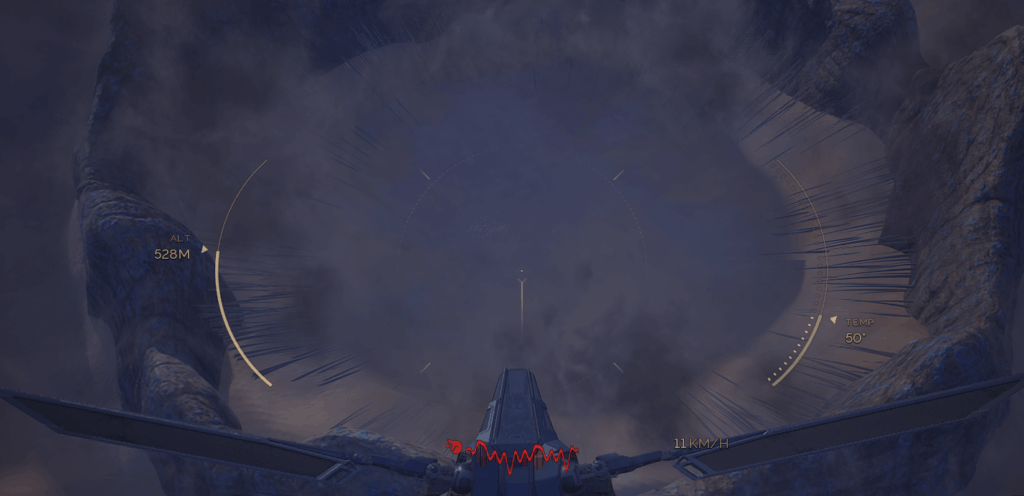
I love Dune. Dune your mom, hah gottem.
No, but really – that Dune captured my imagination decades ago will come as little surprise to anyone who knows me. I spoke at length about Dune on the BPL Podcast with Mr Tex, about the books and the film adaptations and our thoughts on the big themes and ideas of the series and the setting. Dune’s influence on modern science fiction is still felt today (a point I raised on a recent Horizon: Forbidden West stream on WBPL-76), and almost exactly sixty years from when it was first published I find its themes and ideas still resonate.
In addition to being one of the seminal works of modern science fiction, Dune is no stranger to video game adaptations – while the first was a sort of hybrid point-and-click adventure with turn-based strategy, it’s sequel Dune 2 became the blueprint for a game everyone’s heard of: Command and Conquer. I played the remaster Dune 2000 in, well, 2000, the same year Frank Herbert’s Dune aired on television (I maintain to this day that Ian McNiece is the definitive Baron Harkonnen). Later there was a 3D RTS Emperor: Battle for Dune, a poorly-regarded PS2 game titled after the miniseries, and then nothing until Dune: Spice Wars in 2023 when Funcom first got hold of the license.
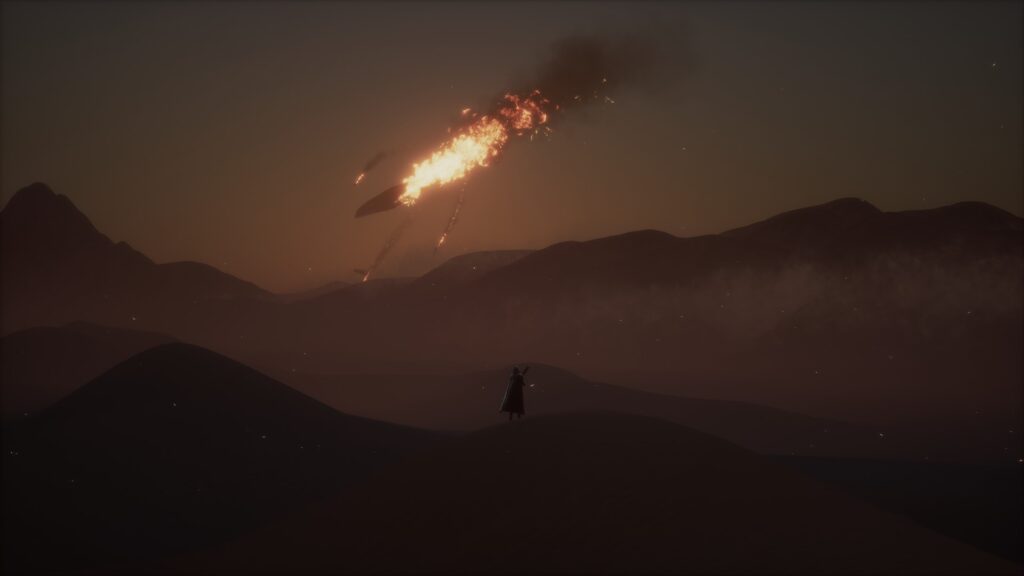
Dune: Awakening isn’t any of those. I first heard in 2022 that Funcom was working on what was described as a “Dune MMO”. I’d heard of Funcom of course – more recently they’d done Conan: Exiles, a sort of Rust-clone I thought was competent enough, but I knew them better as the studio that made The Secret World. Fellow legionnaire and stream cohost Kingsrow ran me through that a number of years ago, and what a ride it was – a master class in storytelling and worldbuilding and, yes, ARG-like investigative puzzles that elevated what would otherwise be another cookie-cutter theme park MMORPG to something unique and unforgettable. It met an ignoble end when the studio encountered financial troubles and continues today in maintenance mode, its grand story still not fully told – but I’ll leave that saga for another time. I had high hopes that a Dune game from Funcom could deliver something we hadn’t seen before, not just a survival-crafting MMO but an immersive story in the Dune setting that played to the studio’s strengths.
It turns out I was right about that. Dune: Awakening‘s storytelling and worldbuilding is superb, atmospheric, immersive. Graphically, musically, aesthetically Awakening nails the feel of Dune, with a clear bias toward the recent films in visuals but nevertheless there’s nods to other adaptations if you look (the Harkonnen building set is clearly inspired by Lynch). One of the radio channels even plays “classical music”, the MIDI soundtracks from the old games. Mass Effect this is not, there’s no branching storyline here with a zillion different outcomes and inflection points – but I think we’re okay with that in 2025, aren’t we? Its main quest may be linear, but its characters, both familiar and new, are charming and memorable and don’t overstay their welcome. I finished what there is of the main storyline in two weeks of play, and there’s certainly going to be more to come. As for faction storylines, I can speak only to House Atreides – while D:A lets you declare for Atreides or Harkonnen, you can betray your faction and switch sides only once and this is not something I’ve done. I found House Atreides’ storyline a breath of fresh air – Far from being the designated good-guy faction the Atreides are depicted as a society at odds with itself, its leaders holding virtues like honour and loyalty above all while the men and women in the lower ranks fight and die in the dirty, grimy, blood-soaked sands of Arrakis. Is there room for honour in a war of assassins?
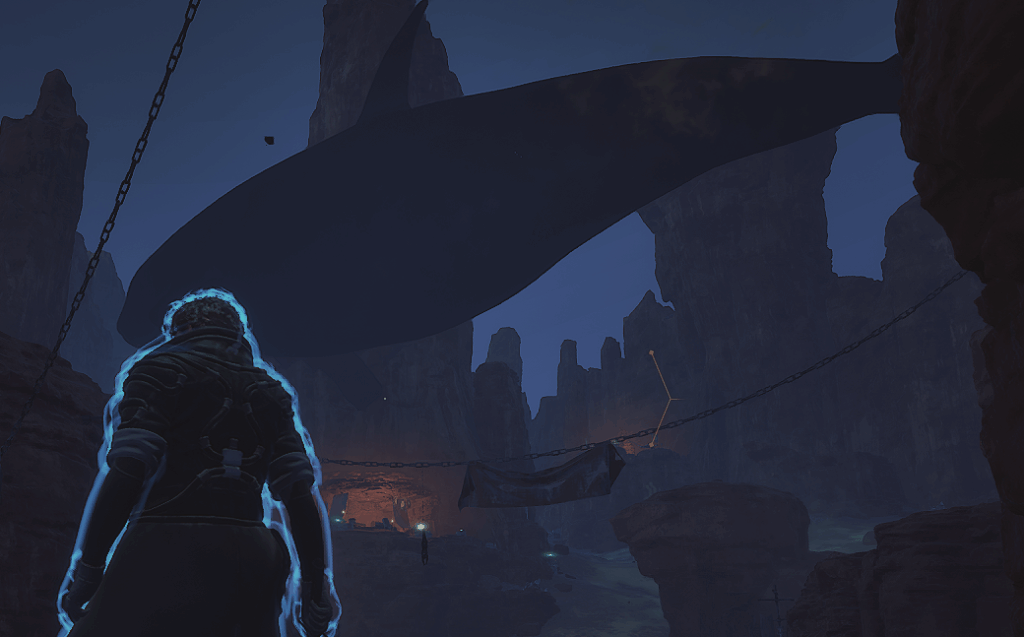
A host of side-missions and contract quests fill the Hagga Basin map with things to do. I revisited locations multiple times, but it didn’t feel arduous or repetitive – I quite liked crawling around the testing stations and shipwrecks and bandit camps and old abandoned sietches. The combat engine is fun – shields block ranged weapons as long as battery charge holds, but the slow blade penetrates the shield – and the various skills and talent trees have a lot of neat tricks that keep fights interesting, if never really challenging. I managed to complete all the contracts, sidequests and story missions in about 80 hours of gameplay – put a pin in that, we’ll come back to it later – so there’s a lot here you keep you occupied.

Something I’ve been keeping myself occupied with is base-building. It’s fun to build things, which isn’t exactly groundbreaking (no pun intended) but it doesn’t have to be. Building is pretty permissive about clipping structures through terrain, and I’ve seen some impressive and very cool looking builds that use rock spires or existing caves as central elements. At least on my server it’s considered courteous not to cover resource deposits with your base (the resources change between weekly storm cycles, but the locations stay the same), so in high-traffic areas you see a lot of skybridges and raised platforms and cliff-castles and the like. Bases decay over time, if their generators run out of fuel and their taxes aren’t paid. There’s some I still see turbines a-whirling just as they’ve been since launch day, old ones return to the desert and new ones pop up where they used to be. There’s lots of space in the Basin to build, just don’t build on open sand or you’ll be worm food.
Beyond the shield wall lies the Deep Desert, the true “endgame” mode. This is the one that got a lot of press coverage in the run-up to launch – a huge desert map that resets every week, with spice blows and giant worms and shipwrecks and all sorts of riches. Apart from its entrance the Deep Desert is a fully PvP zone, and there’s no radar or HUD markers or overview to warn you when another player is coming, or even tell you if they’re friendly. At least it isn’t full loot – you might drop some of your backpack when you die, but you keep your gear unless “Full Salvage Rights” were on the Landsraad docket that week – more on that later. Player-versus-player isn’t everyone’s cup of tea of course, which is why, after months and months of hyping up the harsh deep desert, not to mention an extensive closed beta test, Funcom reversed course and made only half the map PvP mere weeks after launch. Here, unfortunately, is where the cracks start to show: when they cut the PvP area in half, Funcom also changed how the endgame materials spawn to greatly favor the PvP half. I’m sure you can see the problem here: what was meant to be a response to player sentiment against being “forced” to engage in player-versus-player content, actually served to make the problem worse by concentrating the PvP activity, and all the stuff you want from the deep desert, in a region half the size. It didn’t do anything, it just gave the appearance of doing something. It was about optics, not gameplay.
In fact, the topic of gameplay in the deep desert is one I’ve been turning over in my head since I reached the endgame. The final tier of gear progression is glacially slow compared to the first five. Endgame material spawns were infrequent before the change, and today in the PvE zone you’re lucky if you can find one. Spice feels about right in terms of scarcity – there are smaller spice blows out here, just like in the Hagga Basin, the PvE-only region, but the Deep Desert also has huge “ring-mouth” blows that take an entire guild to clear out – at least before the Old Man of the Desert shows up. But the amount of spice needed to make things, likewise the other endgame materials, seems unreasonably high.
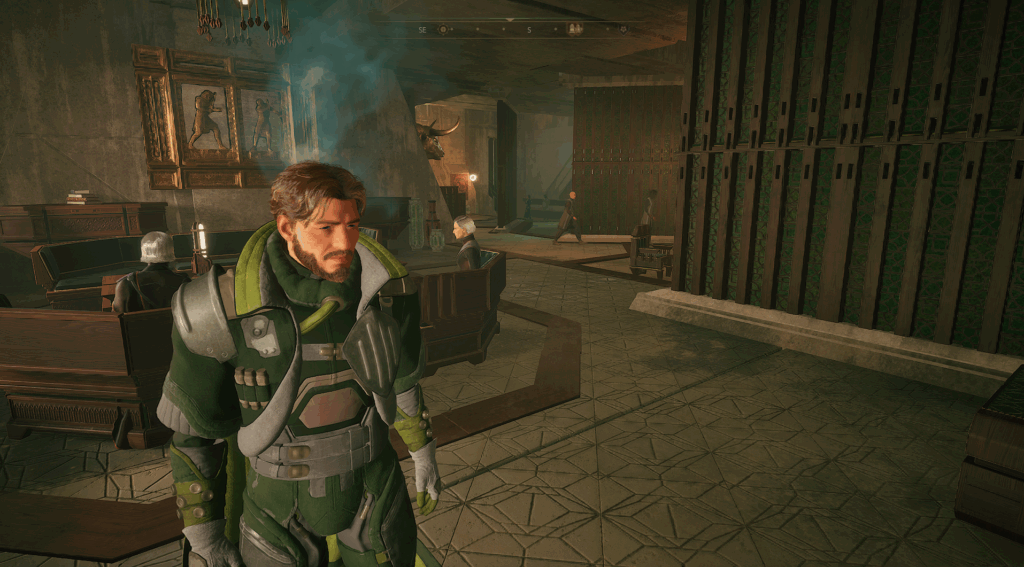
Now perhaps you might say, could you use the player market to supplement your material gathering? Indeed you could, there is a market that can be accessed from either of the big cities (off the map from the Basin, accessibly only by ornithopter). But the market is…primitive, to say the least, with no way other than guessing to know what price other players are willing to pay for things. As far as I’ve seen the most reliable way to make money on the market is by selling schematics, one-off blueprints for special and rare equipment that can be found in testing stations (dungeons) in the Basin and the Deep Desert. But prices fluctuate wildly, and there’s no way to track the history of any goods for sale except to track them by hand. (Why yes, I have been keeping a spreadsheet, why do you ask?) This might seem a minor quibble, I realize not everybody approaches multiplayer games with the same shrewd eye for economics as I do, but I’m an old hand at EVE Online. To be blunt, EVE figured out what you need to run a thriving player-driven economy twenty years ago. Funcom purports to want the same for Dune: Awakening, but seems not to have taken any notes.

And to be even more blunt, a failure to take notes is a recurring theme in the higher-level mechanics in this game. What are we to do in the deep desert, once we’ve scraped and scrounged enough titanium and carbide parts for a full set of tier-6 gear? Why would I need to refine spice, after I’ve built my full-size spice refinery? To sell on the market? And buy what? It’s not entirely clear, which I suspect is why it’s been made so difficult to ascend that final hill of progression: Because there isn’t anything after it. Sure, all gear degrades with use and every repair irreversibly degrades the equipment, so eventually I’d have to replace everything – but what exactly am I using it for once I’ve got it? There’s no territory control or war room map. There’s a war of assassins on, but that doesn’t seem to actually matter – you’re just as likely to be ganked by a squad of Atreides thopters as you are by a gang of Harks. There’s the Landsraad, a weekly collection of tasks to win votes to grant your side powerful boons – but the tasks are all variations of gather bear-asses, and while they unlock at a regular schedule throughout the week they seem to get completed for one side or another very quickly after becoming available. I have a job, Shaddam, I can’t be sitting at my computer waiting for House Greebo to unlock so I can dump my stockpiles of gems and instantly win it for my side. The thresholds are way too low – well not all of them some are stupefying high, those are the ones that go uncompleted. Remember how I said endgame materials are a glacially slow grind? How would you like to dump weeks worth of progress into the Landsraad to, maybe, possibly, improve the chances of your side winning the vote?
Besides which, the progression question again raises its head: if I’ve already climbed Mount Plastanium and progressed to the end, why do I care if this week’s Landsraad vote could improve my refining yields? What am I going to refine when there’s nothing left for me to make?
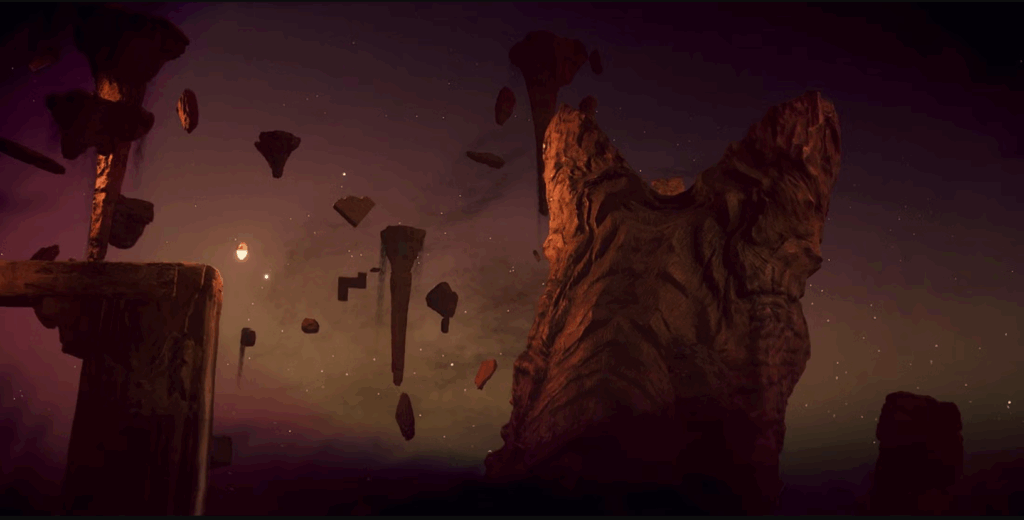
This is a problem every multiplayer game eventually has to contend with. There’s no easy answer except for a gradual march of new content to appease the players, and that new content isn’t scheduled to arrive for a while yet. But as soon as it does, there will be people who plant themselves in front of their computers and grind it out in a matter of days, only to turn around and complain that there’s not even more content. Dune: Awakening has a finite amount of stuff. It is not a forever-game. Is that a bad thing? What’s the opposite of “damning with faint praise”?
My issues with the Deep Desert and endgame progression aside, the fact is I spent eighty hours on Arrakis before I ran out of things to do. That’s more time than I spent getting 100% in Horizon: Zero Dawn. Eighty hours, for about $80 CAD? One dollar per hour is a pretty good conversion rate when you put it like that. You certainly won’t get that from a movie ticket. I sometimes think we have warped expectations in this hobby, about what constitutes a good value-proposition. We expect a lot from video games. And to be fair, Dune: Awakening promised a lot. Does it deliver on everything it promised? No, it clearly falls short in many areas. But there is something here that’s worth your time, and it’s in those eighty hours I spent in the Hagga Basin running from sandworms and sword-fighting slavers. I had a good time.
They say you shouldn’t buy a game on the promise of what it might be later, but on what it is right now. Dune: Awakening might get more content later, might get proper market tools later, might get the Deep Desert and the Landsraad sorted out later, might get a cohesive vision for what kind of game it wants to be in the endgame later. It might get that. But if it never does, what’s here right now is worth your time.
 Will the Great is editor, erstwhile games journo, and part-time shitposter for the Legionnaire. He enjoys pineapple on pizza and movies about sailing ships.