by DoTs
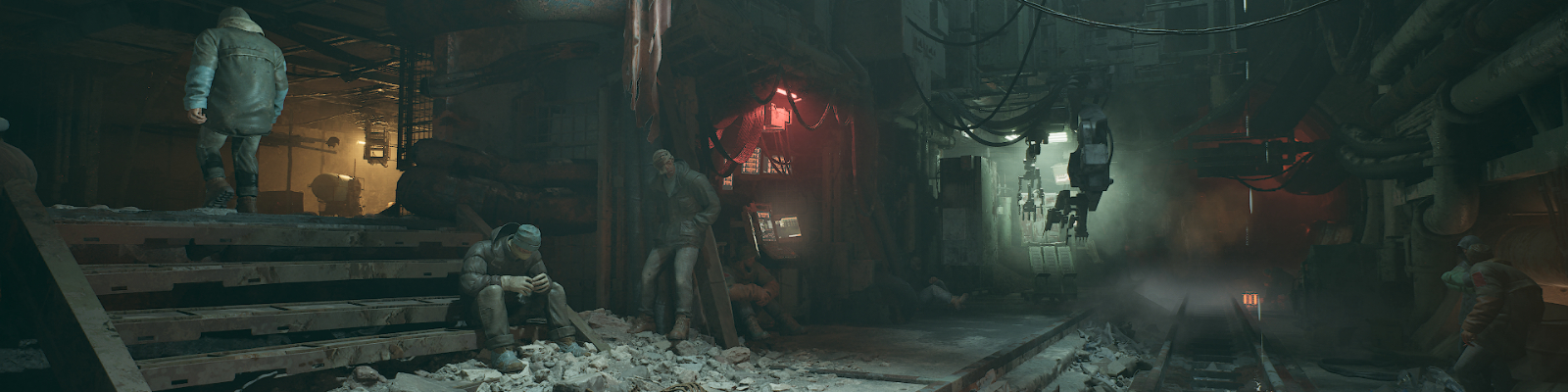
It all starts in a place concealed from the conflict that’s consuming the world above: A settlement of non-combatants hiding from a war that knows no safe places. A shantytown built into old transport tunnels that run beneath a city-turned-warzone, shelter for those who cannot, will not fight. Or did so and lost.
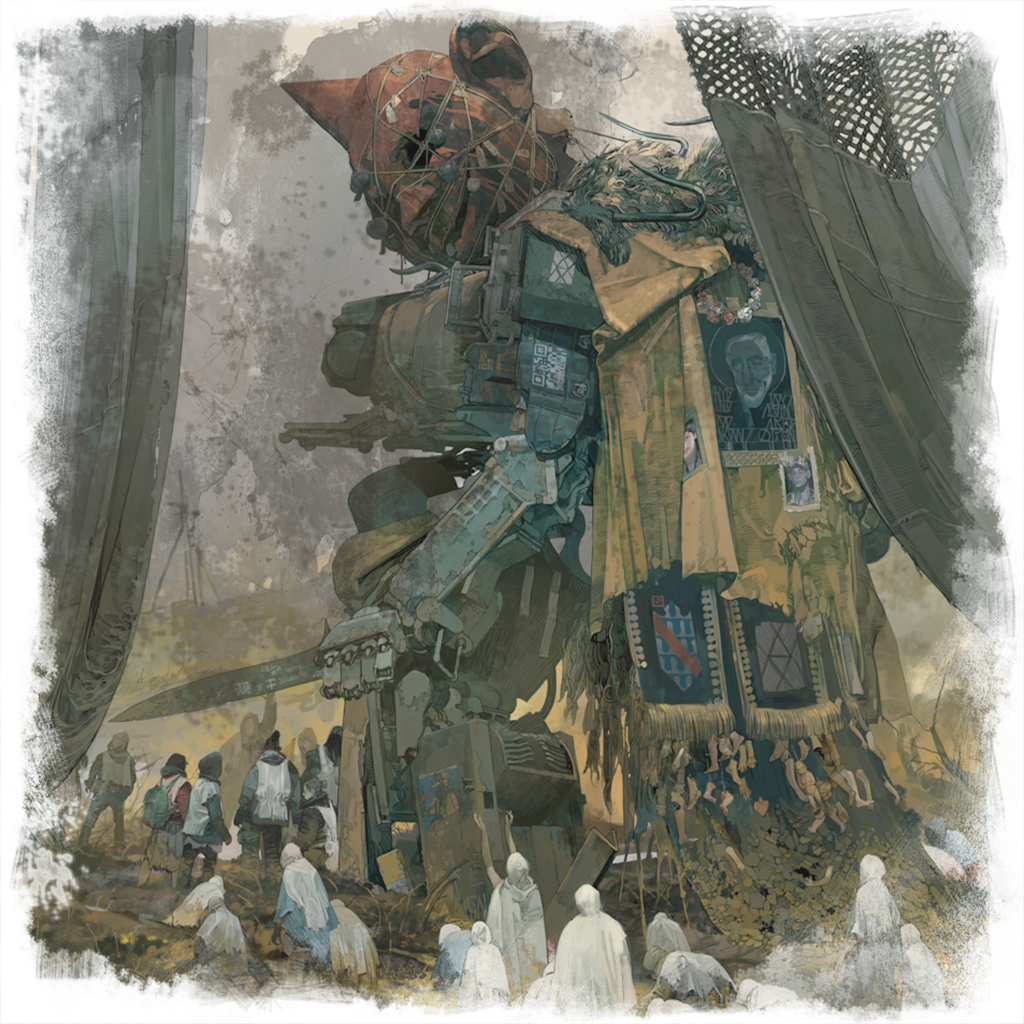
In one isolated corner, a biomechanical behemoth with no face lies breathing heavily, pin-cushioned by bayonets but still alive. Along the front edge, facing a deep drop into a silo whose purpose has long been lost to time, supplicants pray in front of a mural—a painting of a mech, adorned with heraldry and what seems like a statue’s head bound atop it. In the main area, traders slouch at their stations, eyeing passerby suspiciously. An automated terminal, set into a quasi-shrine of arms and ammunition, offers weapons for barter. A thin, mean-looking dog watches the milling crowd with hard eyes.
This is home. This is safety. This place is what all your resources go toward keeping alive, and growing. The Innards, they call it. It’s a place built into the margins, for those outside the status quo of a vicious conflict. But, like anyone, the people here need things to survive. Water is the major one, a scarce resource in this blasted world; the services and population of the Innards depend on your ability to keep water in the tanks.
For that, you’ll have to go outside.
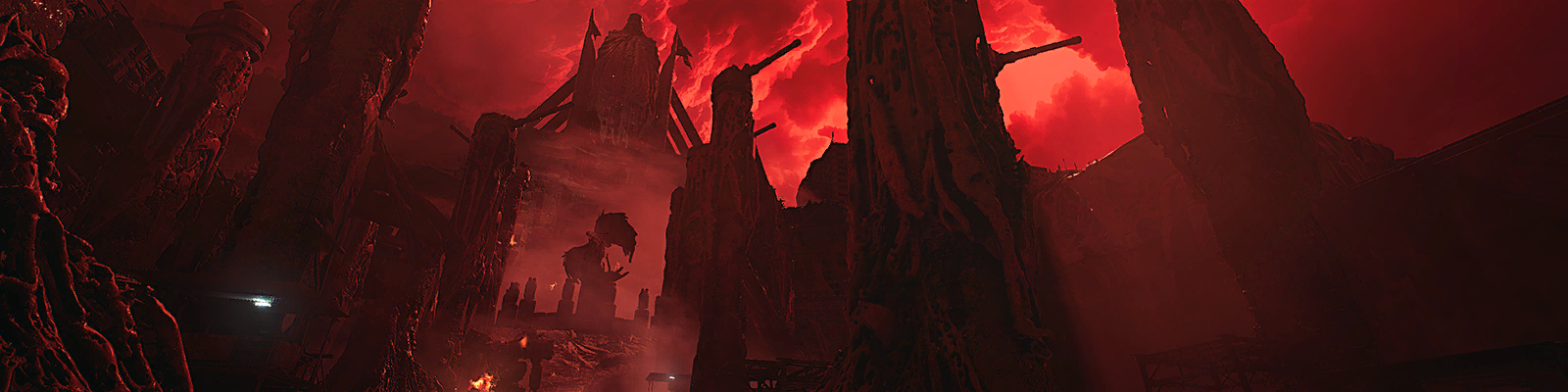
The player’s experience of the Forever Winter revolves around this hub, this home base for the player characters. But the world that Fun Dog Studios has created looms large over this shelter: In the sprawling cityscape above, factions war endlessly and brutally. Running battles destroy parts of the city, only for them to be remade by the AI systems in charge of maintenance, even as they corrupt and change with the constant use. Armies escalate conflict into industrial scale, using soldiers and vehicles as expendable assets. Men and women on both sides are thrown into this meat-grinder of a fight, rarely knowing anything beyond ‘the enemy is here, destroy them.’
But, in the wake of that conflict, resources are left behind. Resources that can keep the Innards, and you, alive another day.
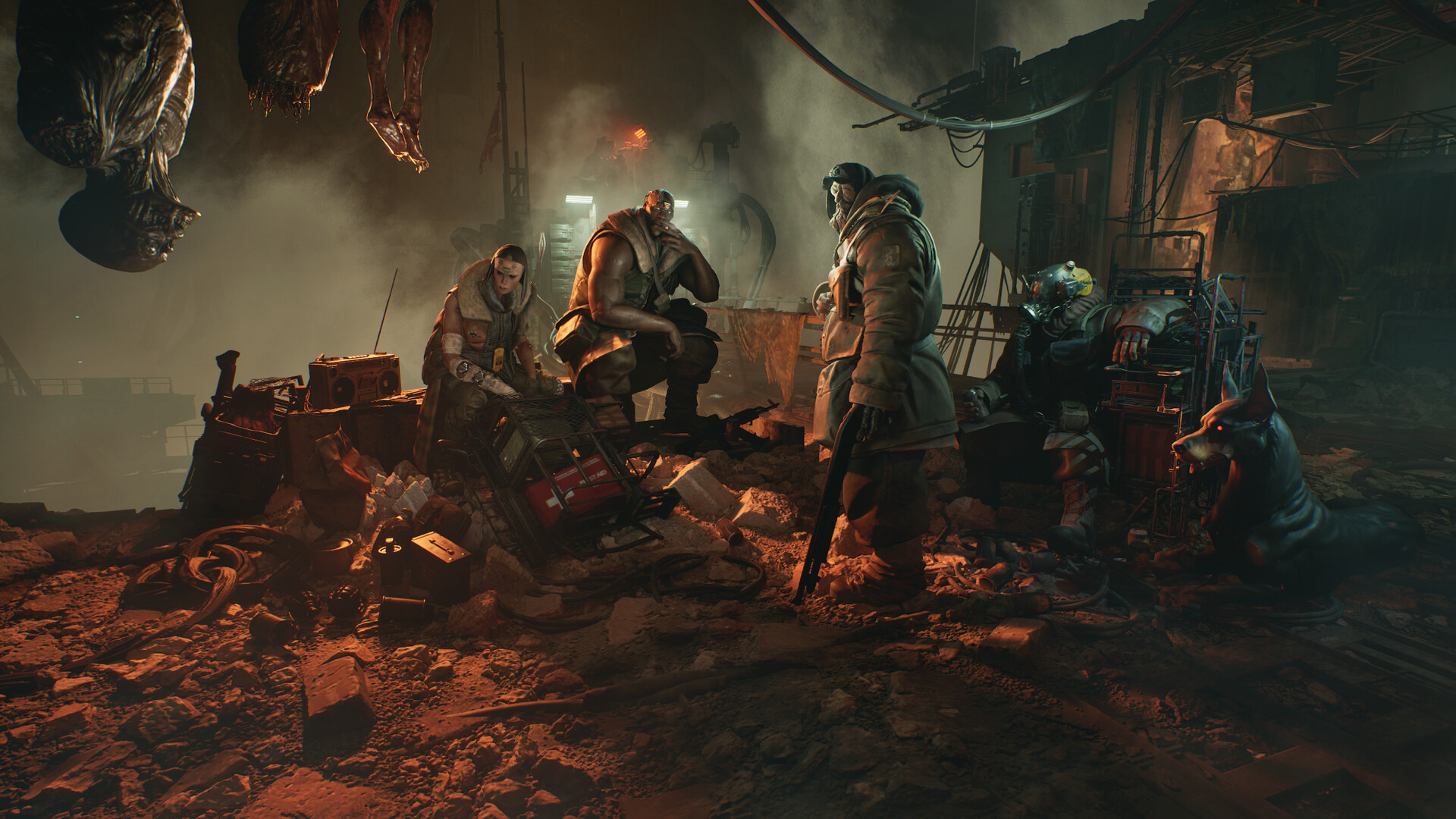
So, time to choose a character and get to work. All of the playable scavs have their own quirks, weapon proficiencies, and available equipment. They are wildly variable, with everything from movement speed to skill trees distinct from one another.
The first is the Old Man. He is a survival-oriented character, his unique skill line being one that makes health-recovery items more effective. Overall somewhat of a generalist, without access to two of the heaviest backpack rigs, but able to take skills that make rifles of all kinds more accurate and effective to use. In runs, his voice is ragged—he comes across as a salty veteran of the city’s war, accustomed to the daily scramble for survival.
Next in line is the Scav Girl. She is the character with the lowest visible threat to the warring soldiers in the city, able to slip by where others would draw fire. This is accentuated by her being the only scav able to wear the ‘tiny’ rig: A single-celled backpack with limited capacity but rendering quieter movement and lower visibility. She has skill lines for both pistols and SMGs, centering around hit-and-fade tactics and fast applications of violence.
Contrasting sharply, Mask Man. He is described as a ‘master-at-arms’ for the scavs, with the ability to learn and wield any weapon other than a specialty machinegun. Combined with his large variety of rigs, and generous health totals, he makes for a capable combatant—at least by scav standards—but is clearly troubled. His voice lines in-mission are very mercurial, sometimes laughing in glee at a great find, other times panicking when he loses hope of survival.
Shaman is next up, and he is less easily contrasted. His backpack limitations are the same as Scav Girl’s, but his quirks are twofold: he can both fit more into those packs, and also benefits more from the tactical camera device in-game. This makes him an effective scavenger and very good at early detection, in order to plan around threats. He is also the most mystically-oriented of the characters, with a more esoteric view of the city around them.
The last human playable character is Bag Man. A hulking, augmented person with the ability to use the heaviest weapons and wear the biggest backpacks in the game. His specialty is in those elements, able to use the HMG weapon class unlike previously-mentioned characters, and wear rigs that allow him to haul back immense amounts of salvage or large items. He comes across as a practical man, devoted to the task of keeping those back home supplied, and alive.
Final mention is the sole robotic player character, Gunhead. Described as a sentient combat AI, it has some of the largest departures from normal styles of play—for one, it is recognized as a severe threat compared to other scavs, and soldiers of both sides have little hesitation engaging it with directed fire. It also has its head-gun: treated as an ability, the weapon can be changed out between different guns, fired independently of carried weaponry, and has its own ammo pool. ‘He’ still has a voice, and wavers between clearly automatic notifications and more personal, conscious snippets of dialog.
No matter which of these characters you choose, the task remains: Go out into the war-torn and mutating city of Lost Angels, secure what you need, and get out alive. The road to this goal will lead you into areas of conflict between the two sides of the war, and bring you into contact with the three distinct factions fighting.
Alone in their fight, but massively supplied and fighting with a theoretical home-turf advantage, is Europa. They are a global power that encompasses most of what we think of now as NATO, but are much more authoritarian. They rely on conventional infantry and mechanized tactics in their warfare—but this doctrine has been expanded to include giant mechs used as weapons platforms, while still fielding tanks and individual infantry squads. They are the most recognizable of the warring armies, with a direct analogue to real-world modern armed forces.
Fighting them is a coalition of two armies. Eurasia is a consolidation of east-Asian nations that, while holding less territory on the globe than Europa, is a massive powerhouse of technological development. The closest they field to standard infantry are cyborg soldiers housing human brains. Rather than a normal doctrine, they revolve around special-purpose squads, with everything from cyborg conscripts as shock troops, to massive bombers piloted by human brains used purely for their processing capacity while the ‘pilot’ is in a medical coma.
The other half of the coalition is Euruska. Allied with Eurasia, and supplied with the more biological-focused technologies developed there, they are a federation of various slavic states that has leaned fully into the practice of bio-engineering. They field infantry and tanks like Europa, even employing their own large mechs, but the similarities stop quickly—Euruskan units are tough, heavily armored, and not always recognizably human. They carry heavy weapons, or field horrors like the ‘grabber,’ and work closely with Eurasian forces to recover material and bodies from fields of battle.
None of these factions are a friend to you, as a scav. The best you can hope for is that they will simply ignore you as they fight savagely amongst themselves. In their wake, they leave things behind that you need to survive and progress. Quests are one motivating factor, given by faction representatives available for contact in the Innards. Do things or retrieve items for compensation, simple. But equally important, and another driving force to get back out into the city, are your own projects and development of the Innards themselves.
After all, you can improve this place. Make the tank for storing water bigger, get a bench where you can reload your own ammo, even carve out a personal room for yourself and decorate it. This place doesn’t exist only for you, but it is your home, and it is worth investing in. So while you scavenge and quest for water, there are other objectives of your own to pursue as well. Things to seek and drag back, items to find for yourself, not some faction rep assigning you a job. Material you ask the city itself for, and hope it answers.
And sometimes it does, though rarely in the way you would hope. The city of Lost Angels itself is a technological marvel: Designed to be a self-regulating, self-repairing urban center, the works that continue even in the war-torn era of the game are so miraculous they border on magic. 3D-printing of materials by automata, the reconstruction of entire city blocks overnight, the functional power infrastructure even after years of military conflict and destruction—all achieved through existing systems still alive in the city.
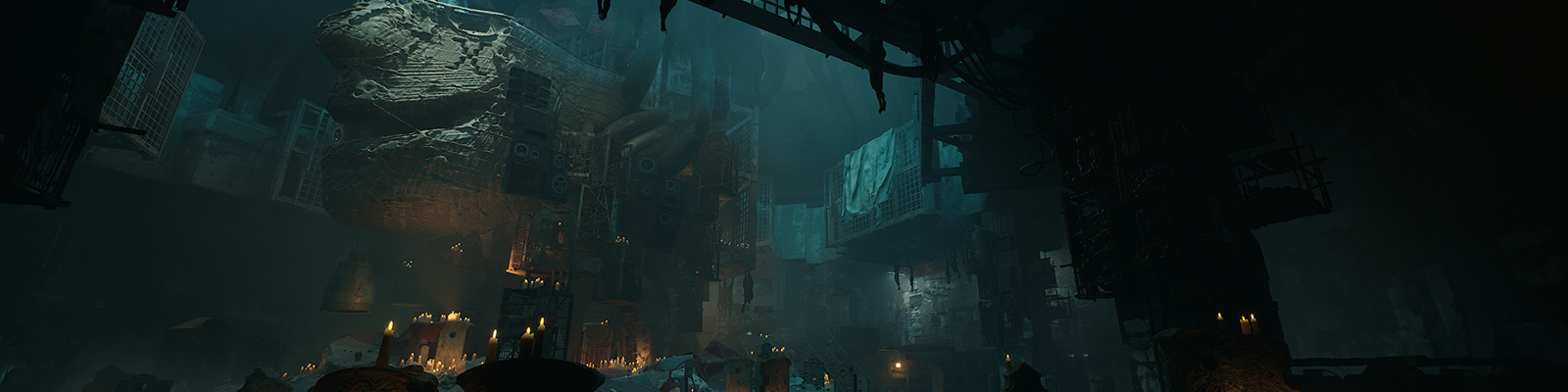
But it is not static, not stable. The designs that the automatons reconstruct begin to change, to mutate. They come out twisted, or just different. A flat rectangle turns into a spiral. A statue now smiles. With so much death and destruction, the very machines that are tasked with maintaining the city begin to depict it as well—all driven by an unknown, uncontacted AI system that has no parameters to quantify what is happening to it. As one character puts it: “This city is alive, and it’s terrified.”
And so should we be. Giant treaded landcrawlers the size of entire city blocks strongpoint theoretical objectives, while mechs carrying rifles as large as tank cannons fire indiscriminately into what should have been skyscrapers. Bombers swoop low, disgorging a torrent of zombie-esque cyborgs that single-mindedly run at enemies and beat them with metal fists. Giant totemic machines designed to look like goddesses of the battlefield retrieve corpses of human and cyborg alike, gathering them like berries from a forest. Corpse processors jam from overwhelming input, leaving brigades to starve until they’re fixed. Blood and ash clog entire neighborhoods with silt while soldiers fight on, adding more to the mixture.
And, through all of this, you must find what you need. The people of the Innards are relying on you. It is within your power to see another day, maybe even make that day a little better. Amidst the horror, there is beauty to be found in the shared human experience—from contacting people through a transmission tower to swap stories, to sharing a drink with soldiers of both sides in a scratch-built bar, the game has a keen understanding that people are what keep other people going.
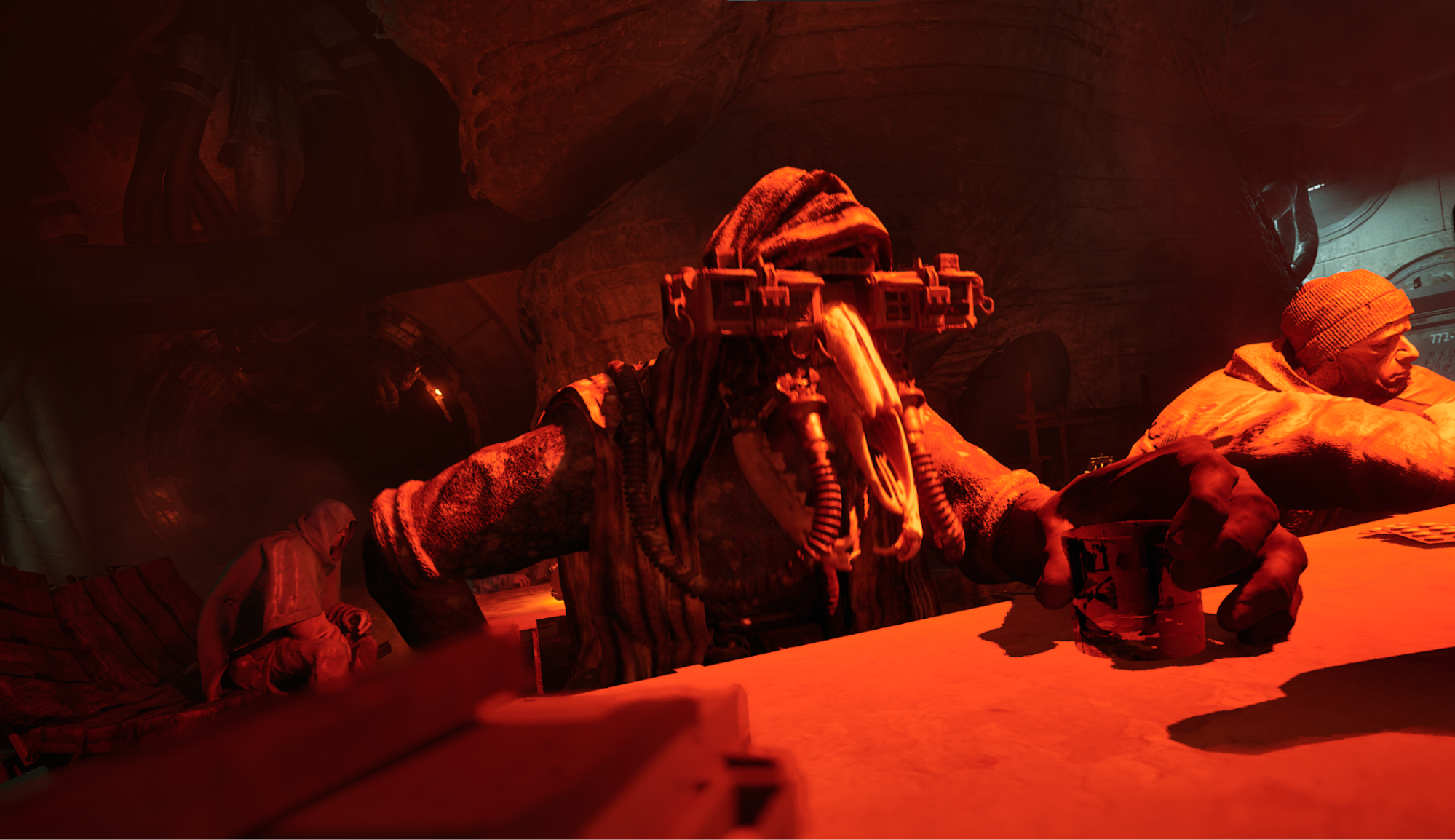
A Euruskan cutler hones blades to such a fine edge it makes his commanders uncomfortable. A Eurasian bomber pilot realizes with horror that she has ‘woken up’ while still on-mission. A Europan medic dwells deep in the memories of the lives she couldn’t save. A Euruskan priest muses on the value of his religion compared to the lives of his comrades. A wandering scav cradles and worships the core of pre-war vending machine AI. All of these interactions are your reward for doing your duty, keeping the Innards alive and growing.
So return to the surface. Dodge gunfire traded between warring soldiers, pick through storage crates and dead bodies for the things you need. Hunt them yourself, firing your weapon and hoping it doesn’t draw attention enough to bring your own destruction. Delve into the different parts of the decaying, regrowing, adapting city and steal from the impassive walls. Demonstrate your prowess and allegiance to the different faction reps, in return for materials and water. Dance through the never-ending rhythm of bullets and blood and come out the other side. Make it home to face the next time.
Because there will always be a next time. It’s worth facing the next day for the people who rely on you, the connections you make. Bar patrons, voices on the radio, all the other people in the horror of this city and this war who are trying to make it work as best they can—they are who keep us going, keep us running, keep us scavving. No matter what the world looks like above, no matter the ash that clouds the sky, the job is the same: Get what you need to keep you and yours alive, for one more day.
This is the beauty underneath the horror of The Forever Winter. The world is large and indifferent to us, but by surviving it, the potential to make our own place in it never goes away.
Keep scavving, keep making it, keep you and yours alive.
[images used in this article were sourced from in-game screenshots, the game’s Discord channel, and The Forever Winter wiki, a community-led online resource for players.]
 DoTs is a local gas masked figure with an unquiet mind and a full bookshelf. When not drinking coffee, he can be found ravenously devouring anything with an iota of story in it, from books to movies to videogames.