How a BattleTech Romance Became a Novel-Length Writing Lesson
by Lady Red
 There is an official BattleTech romance novel.
That sentence is already funny. It arrives fully dressed in its own punchline. BattleTech, a setting famous for giant stompy war machines, dynastic grudges, succession wars, political atrocities, mercenary contracts, questionable logistics, and people making terrible decisions with nuclear budgets, somehow also has a romance book.
That book is Hungry Like the Wolf by Christina F. York.
And I rewrote it.
To be clear from the outset, this article is not meant as a personal attack on Ms. York. I do not know the circumstances under which the original book was written. I do not know the brief, the deadline, the editorial process, or how much freedom the author had. Writing tie-in fiction is work. Paid work. Difficult work. Often thankless work. I respect that.
But I also write. I teach and talk about writing as an art form every Friday on Twitch stream for WBPL76. I talk about the craft of writing, the rules and how and why and when to break them… and when not to. What makes for a compelling story, versus what does not. How theme and focus and message let us connect with other people.
And Hungry Like the Wolf fascinated me because it felt like the perfect bad example.
Not because the premise was silly. Silliness is glorious. I love silliness. The problem was that the original seemed content to be funny… just because it existed. The joke was: “Wouldn’t it be funny if there were a BattleTech romance novel full of bad romance tropes?”
Yes. It is funny.
For about nine pages.
After that… a novel still has to be a novel.
Characters still need to change. Conflict still needs to matter. Romance still needs a shape. Jokes still need timing, rhythm, and escalation. A parody cannot survive on pointing at a genre and saying, “Look, tropes!” A joke can get a reader through the door, but craft has to keep them in the room.
That was where the rewrite began.
Twitch Chat Made Me Do It
Every Friday, I host a stream where I talk about writing, art, worldbuilding, and whatever creative catastrophe my community and I are currently turning into a respectable disaster. We are building our own setting. We talk about novels. We talk about structure. We talk about why a scene works, why a character lands, why a joke needs sincerity underneath it, and why a premise being ridiculous is not an excuse to write lazily.
So when another member of the Legion sent me the original Hungry Like the Wolf, it naturally became a subject of discussion.
At first, I thought I might rewrite the opening chapter as an exercise. Perhaps as a more serious BattleTech romance. I still think that is a good idea, by the way. The Inner Sphere has more than enough room for yearning, bad decisions, political marriages, battlefield trauma, and extremely complicated feelings about people who own BattleMechs.
But chat, as chat often does, had other ideas.
The suggestion became: what if we rewrote it in the style of Chuck Tingle?
Now, that sounds like the sort of sentence that should trigger some kind of safety protocol. But it was also an interesting challenge. Chuck Tingle is not simply “the funny title guy.” The surface joke is obvious, yes, but underneath the absurdity there is often a weirdly sincere moral engine. His work frequently commits completely to an impossible premise while still arriving at genuine affirmations about identity, consent, respect, and love.
That was the key.
If we were going to do this, we could not half-ass it.
We had to whole-ass the shitpost.
The Problem With Being Only a Joke
The original Hungry Like the Wolf is, in concept, very funny. It gives us Alaric Ward, ilKhan of Clan Wolf and First Lord of the reborn Star League, as the romantic lead. It gives us Darvendra Ellstone, a humanitarian doctor, as the woman brave or unfortunate enough to become entangled with him. It gives us a romance setup in one of the least romantically sensible political contexts imaginable: post-conquest Terra.
There are good ingredients there.
The problem was that, to me, the original did not cook them.
The characters were not enjoyable enough to follow. The conflicts had a habit of appearing and then dissolving before they could develop teeth. The romance did not build through curiosity, respect, vulnerability, and consequence. It leapt too quickly from hostility to attraction without making me believe in the journey.
That matters. Especially in romance.
Enemies-to-lovers is not “these people shout and then they are horny.” It is a progression. Conflict becomes curiosity. Curiosity becomes respect. Respect becomes attraction. Attraction becomes vulnerability. Vulnerability becomes some form of commitment, even if that commitment is complicated, temporary, doomed, or bittersweet.
Without that progression, the trope is only a costume.
And that was my biggest frustration with the original. Not that it was silly. Not that it used tropes. Tropes are tools. I love tools. The problem was that it felt like a collection of romance gestures without the emotional architecture that makes those gestures satisfying.
So the rewrite became a public craft exercise.
What would I do differently?
How would I take the same broad beats, the same basic joke, and make it funnier by making it better?
What Chuck Tingle Taught Us About Sincere Absurdity
The first lesson from Chuck Tingle was simple: take the absurd literally.
Do not wink from inside the story. Do not have the narrative shuffle its feet and mutter, “Yes, yes, we know this is stupid.” The fact the thing exists is already the wink. Inside the work, everyone must believe in the reality of the nonsense.
That principle became essential.
If a janitor assassin falls off a balcony, the characters do not pause for a rimshot. They respond according to who they are. Alaric Ward evaluates the event through the mind of a paranoid warlord. Chance Vickers reacts like a woman who has had quite enough of this nonsense and may need a body bag. Darvendra is appalled, irritated, and immediately ready to argue. The absurdity works because the story does not stop to announce that it is absurd. It does not need to deliver the punchline to the reader via Elemental Mailman.
The second lesson was simplicity of language as texture.
Tingle’s prose often has a blunt, direct quality. Feelings are stated plainly. Moral lessons are not buried under seven layers of subtext. That does not mean the writing has to be careless. It means clarity becomes part of the joke and part of the sincerity. The story can say what it means. The characters can learn obvious things in obvious ways because the emotional honesty is part of the charm.
That was useful for this project. A BattleTech romance parody does not need to be subtle about the idea that love, respect, and consent matter. It does not need to hide the lesson that powerful people should remember the small lives beneath their grand designs. It does not need to pretend that “war is complicated” is a shocking revelation. The point is not to be smarter than sincerity. The point is to let sincerity survive the ridiculous battlefield around it.
The third lesson was tonal dissonance.
A story can be wildly stupid and emotionally honest at the same time.
That was the magic trick I wanted. The rewrite needed to contain chapter titles like “A Meeting That Was Not An Email” and “Abduction By Stationary.” It needed to have a ficus matter more than any ficus has a right to matter. It needed jokes about bureaucracy, Clan weirdness, bad diplomacy, and the sheer social hazard of putting Alaric Ward in a room with civilians.
But it also needed a real heart.
The romance had to matter. The ending had to hurt a little. The characters had to leave each other changed, otherwise the joke would just wear off.
What Pratchett Taught Us About Systems, Bureaucracy, and Humanity
The other major influence was Terry Pratchett.
Not in the sense of trying to imitate him directly, because that is a mug’s game and the mug is on fire. But Pratchett understood something vital: systems are funny because people live inside them.
Bureaucracy is funny. Politics are funny. Institutions are funny. But they are also where people get crushed, saved, delayed, misfiled, promoted, betrayed, and occasionally allowed to do the right thing if they can fill out the correct paperwork in triplicate.
That was perfect for BattleTech.
The setting is already full of systems. Military hierarchies. Noble houses. Clan traditions. Mercenary contracts. Industrial logistics. Succession politics. Supply chains. Ancient grudges wearing uniforms. If you are going to set a romance on Terra after Alaric Ward has conquered it, then the romance should not float in a little bubble of candlelight and abs. It should collide with planetary reconstruction, humanitarian relief, political legitimacy, agricultural cycles, infrastructure repair, insurgency, propaganda, and the question of whether stability under a conqueror is better than chaos under everyone else.
That is where Crescent and Cross became important. It sort of started that way in the original, but with Pratchett’s ability to turn a microscope on society in mind… we set out to make it better.
Darvendra could not simply be “the woman who yells at Alaric Ward.” She needed a system of her own. She needed obligations, colleagues, meaningful rivals, institutional power, and institutional limits. She needed to be responsible for something. Not just emotionally, but structurally.
That let the romance connect to the plot. Every time she talks to Ward, it is not only flirtation. It is negotiation. It is triage. It is governance. It is two people trying to understand each other through incompatible scales of responsibility. Again, the original narrative had this… but no weight in. Things did not go wrong. Crescent and Cross in the rewrite though? They managed to lose multiple vehicles, misplace Little Plowboy Three, and corrupt an automated call line into pure absurdity.
Darvendra thinks in people, farms, hospitals, supply routes, staff, and hungry civilians.
Ward thinks in empires, war footing, political control, military readiness, and the future of the Inner Sphere.
Neither scale is false.
The story lives in the tension between them.
Finding the Problems: Character, Conflict, Romance
When I broke down the original, the first problem was character change. The leads started angry and, essentially, stayed angry until attraction took over. That is not enough. Attraction is not transformation. Desire is not an arc.
So Darvendra changed first.
In the rewrite, she is not simply a hyper-competent doctor who conveniently becomes CEO. She is someone elevated into leadership after catastrophe. She has experience on the ground, but not enough experience at the top. She wants to affect not only individual patients, but the structures that decide who gets help and when. That gives her idealism teeth, but also gives her room to be wrong.
Her anger at Ward is morally understandable. He conquered her world. He broke things she now has to help fix. But if she begins and ends at “war bad,” then she does not grow. So the story forces her to confront harder questions. What does stability cost? What happens when the alternative to occupation is not freedom, but another wave of violence? If she helps Ward rebuild, is she helping Terra survive, or helping a conqueror consolidate power?
That is a much better moral trap.
Ward, meanwhile, had to become Alaric Ward again.
Whether one likes him in canon or not, Alaric is not supposed to be a bland romantic android. He is aggressive, cunning, arrogant, adaptive, politically dangerous, and shaped by a life of war, captivity, ambition, legacy, and manipulation. He is not a man who should be baffled by politics or women or basic human emotion. He should be dangerous because he understands more than people want him to understand.
So the rewrite treats him as a man still trapped in war footing. He sees threat vectors everywhere. He understands ambition in others because he is ambitious himself. He does not enjoy Terran politics, but he can navigate them. He is not stupid. He is exhausted, paranoid, grandiose, and often correct in deeply inconvenient ways.
Darvendra fascinates him not because she is “not like other girls,” but because she believes small things matter with the same ferocity that he believes history matters. She pours herself into one wounded planet with the intensity he brings to the future of civilization.
That lets them change each other.
Darvendra learns that large-scale brutality sometimes comes from informed necessity rather than cartoon villainy.
Ward relearns that small lives are not merely resources inside the machine. Farmers, doctors, clerks, pilots, local officials, repair crews, frightened civilians, and people with tiny hobbies and annoying houseplants are not beneath history. They are what history is made of.
That is what romance is made of. Attraction that happens while life events go on. I have always believed romance is not really a core genre. It is a focus made of other genres, because love doesn’t happen in a vacuum.
And sometimes, it happens in hot mech cockpits declaring a Trial of Valentines. It isn’t always tidy. Or sane.
Keeping the Stealth Atlas
Homage means knowing what to fix.
It also means knowing what to keep.
The original Hungry Like the Wolf contains what I can only describe as the unintentional Stealth Atlas II. I adore it. No notes. The idea of an Atlas II hidden in plain sight is so magnificently stupid, so perfectly unthinking BattleTech, that removing it would have been an act of cowardice.
So we kept it.
More than that, we embraced it.
The Stealth Atlas became a symbol of the entire rewrite philosophy. If something from the original was funny, useful, or weirdly inspired, the job was not to sneer at it. The job was to make it work on purpose.
That is an important distinction. This was never about sanding the absurdity away until only a sensible romance remained. Absolutely not. Chat wanted Tingle. The absurdity is part of the charm. The question was how to support it with structure, timing, and consequence.
A hidden Atlas II is funny.
A hidden Atlas II that appears inside a scene with military geometry, public relations theater, political messaging, and Darvendra realizing Ward expected trouble all along? That is funnier, because it is now doing narrative work.
It is still ridiculous.
It is just no longer weightless or potentially unintentional. It is now absolutely stomping in at 100 tons of armor and damn any logic trying to get in the way.
Making Alaric Ward Likeable, Somehow
I am as surprised as anyone that Ward in the rewrite is likeable. Since its completion, not only have I recieved messages from people annoyed they like this version of them, but some even thought he was the best character in the rewrite.
Alaric Ward is not an easy romantic lead. He is a conqueror, a political predator, a Clan warlord, and a man whose relationship with humility could generously be called ‘long-distance’. Making him likeable did not mean making him soft. It did not mean apologizing him into blandness. It meant giving the reader reasons to enjoy watching him think.
Competence is attractive. So is restraint. So is the ability to listen.
Ward in the rewrite is still arrogant. He is still dangerous. He still has the emotional accessibility of a sealed bunker with active point defense. But he listens. He learns quickly. He is amused by Darvendra because she is direct, and he values directness. He begins to understand that her optimism is not weakness. He’s also over confident enough to get two whole pick up lines in the novel and actually carry them with something approaching competence and no cringing.
The route to making him likeable was fairly simple. Treating him as a man first. Not a Clanner. Not a scion of Clan Wolf. Not the ilKhan. First, he should be a person who happens to also be those things. Yes, those shape him, but that shaping should still be massaging core human traits (likeable or not) that a reader and understand. And potentially appreciate.
He does not become a golden retriever in a fancy uniform.
He does not reduce down to just a machine of animal lust for the first person in a skirt who will speak directly.
He does not forget that the reformed Star League is bigger than one planet.
He does adjust to things he genuinely wouldnt have seen before, and react like a person. Even if that strange thing is apple bobbing and a tractor pull.
Person first. It’s a surprisingly overlooked trick.
Darvendra, the Ficus, and the Miniatures
Darvendra needed texture too.
One of the joys of working with a live community is that ideas arrive from strange angles. Some are jokes. Some are throwaway lines. Some are terrible and must be taken outside with a shovel to see the rabbits.
But some become load-bearing.
Darvendra painting and arranging miniatures became one of those details.
For BattleTech fans, miniatures are not just a cute hobby. They are part of the culture around the setting. Giving that hobby to Darvendra connected her to the audience in a way that was both funny and sincere. Here is a humanitarian doctor and reluctant institutional leader who deals with the consequences of war on a planetary scale, and in her private time she paints tiny war machines. That is a joke, yes. It is also character.
The ficus was similar.
The original Darvendra had cactus energy. The rewrite made Darvendra a crazy ficus lady. Why? Because it was funnier. Because a ficus is an inherently office-coded plant. Because bureaucracy and houseplants belong together. Because giving a character something specific to fuss over makes them feel more human, even more so when its something that can’t even argue back.
Big emotions need small anchors.
Grand political romance is all well and good, but sometimes the reader remembers the plant. And I am pleased to report Sebastian the Ficus still remains uneducated on politics.
Why the Ending Had to Matter
The rewrite could not end with Alaric and Darvendra simply riding off into the sunset together.
That would betray the setting. It would betray the characters. It would also be politically deranged.
He is the First Lord of the Star League. She runs a planetary humanitarian organization. Their relationship cannot become a simple public happily-ever-after without detonating both of their roles. A permanent romance would turn Darvendra into a political liability and Ward into an even larger target for every accusation of favoritism, manipulation, or Terran compromise.
So the ending had to be honest… but also earned and satisfying, unlike how I felt after reading the original.
Darvendra and Alaric can matter to each other without belonging to each other forever.
That, to me, is more interesting than forcing a conventional romantic conclusion onto a story that cannot support it.
Love has many forms. Some relationships change the course of a life without becoming the structure of that life. Some people arrive at exactly the right time to teach you something, wound you slightly, comfort you unexpectedly, and then remain in memory as proof that the world was not as narrow as you thought.
For Darvendra and Ward, the romance becomes a temporary shelter, a lesson, and a scar.
They cannot stay together.
But they are better because it happened.
That is the part that matters. That was what made this project surprisingly worthwhile.
The original joke was “what if Alaric Ward was in a romance novel?”
The better question became: what would it take for that romance to mean something?
The Cover, the Community, and the Joy of Taking Dumb Things Seriously
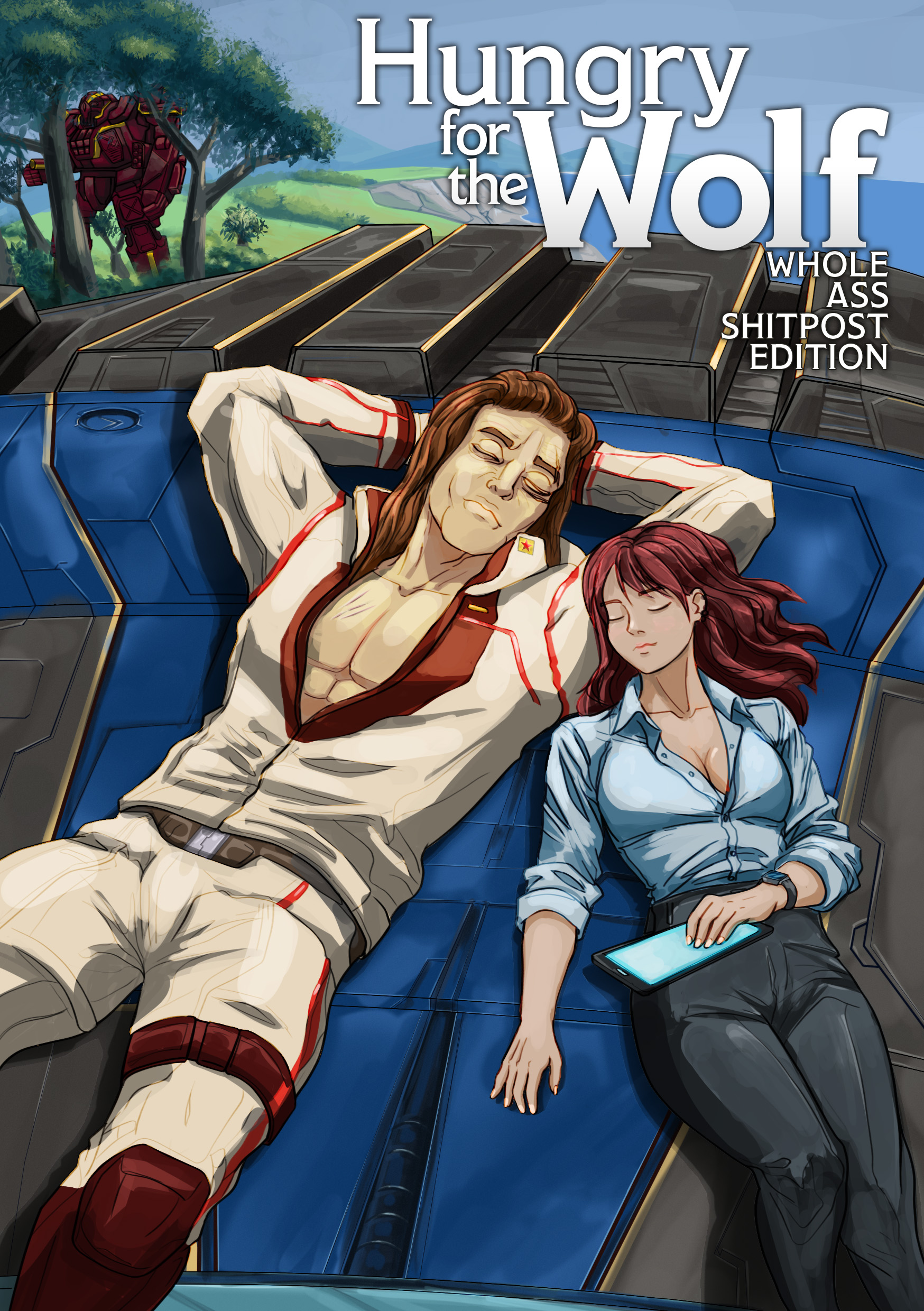
The rewrite did not only get a new story. It got a new cover.
The original cover joke, as I saw it, was simple: Alaric Ward, famously not a stereotypical romance-cover dreamboat, presented shirtless and smiling at the reader in the familiar visual language of the genre. That is funny.
But because this entire project had become an exercise in whole-assing the bit, my Twitch cohost Lictor took it upon himself to make a new cover.
And that cover did exactly what the rewrite tried to do.
It was still a joke. It knew what it was. It carries the magnificent phrase “Whole Ass Shitpost Edition” with pride. But it is also more sincere.
More specific to BattleTech. More interested in the characters as people inside a setting rather than cardboard cutouts pasted over a romance template. And, most importantly, it had the Stealth Atlas in the background, because some jokes deserve monuments.
That cover is a perfect emblem for the project.
Yes, this is stupid.
Yes, we cared.
Those two facts do not contradict each other.
In fact, that may be the entire lesson.
Whole-Ass the Joke
The joy of writing is not reserved for respectable premises.
Sometimes writing is noble tragedy. Sometimes it is intricate worldbuilding. Sometimes it is a vampire epic, a war story, a literary character study, or a quiet little piece about grief. And sometimes writing is looking at an official BattleTech romance novel and saying, “I think this could be better if we treated the nonsense with the seriousness nonsense deserves.”
That was the heart of this whole daft adventure.
A bad example can teach you. A frustrating book can become a workshop. A Twitch chat full of gremlins can become a writer’s room. A joke can become a novel-length craft exercise if everyone involved is willing to ask not only “is this funny?” but “could this be good?”
Because funny is better when the reader cares.
Parody is sharper when it understands the thing it is parodying.
Absurdity lands harder when the characters believe in it.
And even the dumbest premise in the Inner Sphere deserves to be written properly.
So yes, I rewrote Hungry Like the Wolf.
Not because I hated that it existed.
Because I loved that it could have been more.
And because, somewhere between Chuck Tingle, Terry Pratchett, BattleMechs, ficuses, humanitarian logistics, Twitch chat, a Stealth Atlas II, and the terrible burden of making Alaric Ward likeable, we found the thing I keep trying to teach every Friday:
Writing is joyful.
Craft matters.
Whole-ass the shitpost.
You can find a copy of Hungry Like the Rewrite in the Auxilliary Discord, from Lady Red directly and coming to this website in the near future! The VoDs of Lady Red reading it are available on Youtube in their own playlist.
We’re also making an audiobook for Christmas.
This is a threat.
 Lady Red is a digital artist, novelist and unapologetic British person. She is wanted in multiple States for unlicensed reading of bad literature until morale improves. Also a grand purveyor of mobile blood banks